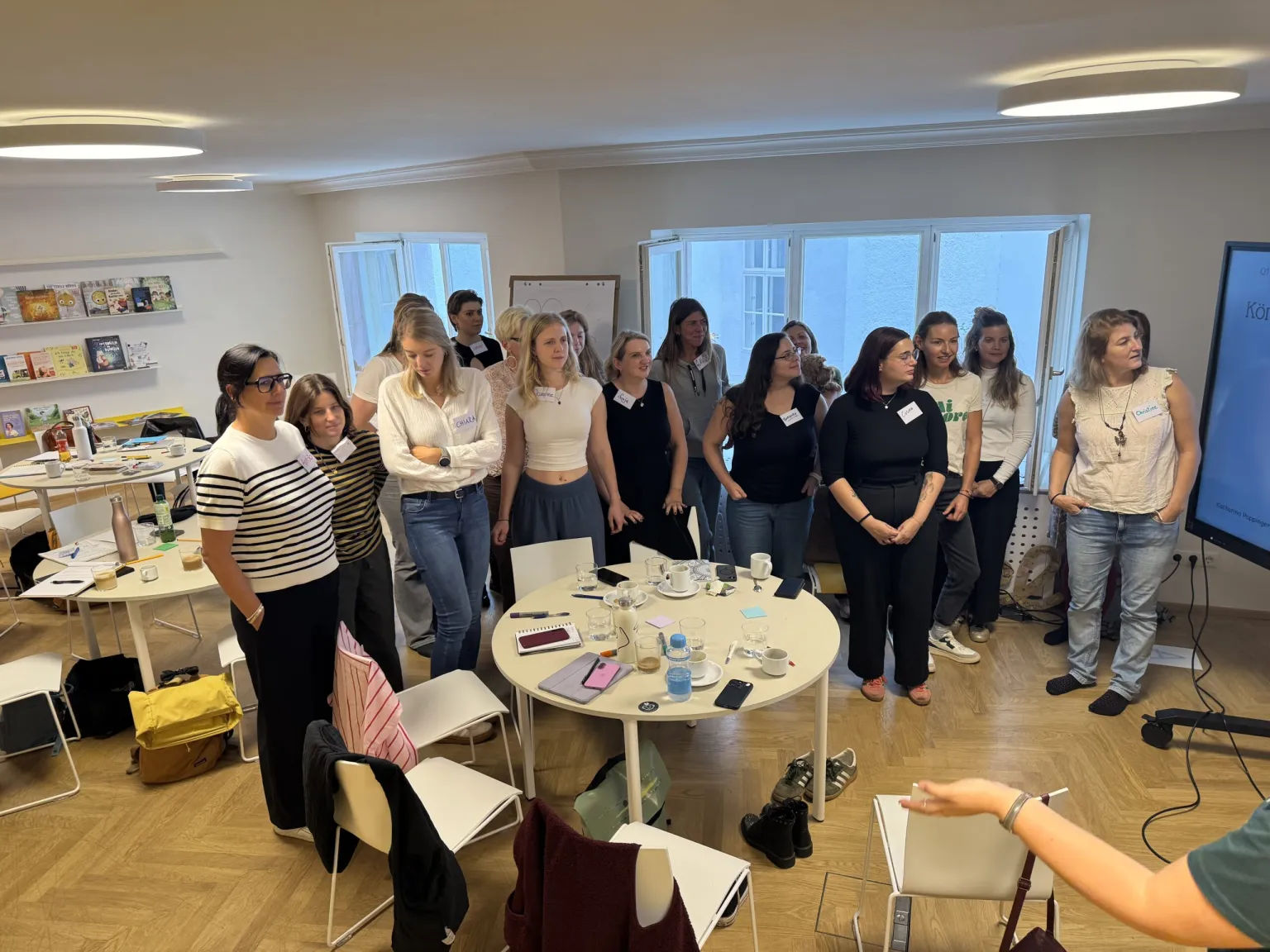
After months of planning, the time had finally come on 11 and 12 September. Two days full of exchange, knowledge, practice, and a whole lot of positive energy: the Stabil im Kopf Trainer Academy 2026/27. Alongside subject-specific foundations, the focus was on didactic and methodological skills as well as the quality assurance of our workshops.
Onboarding new trainers – more than just a training course
The Trainer Academy is an important part of the onboarding of new trainers at Stabil im Kopf. But trainers who already actively go into schools for us can also take part, to refresh their knowledge and get new ideas. The Academy lays the foundation for all trainers to be well prepared for their task and to be able to deliver workshops throughout Austria in a professionally sound, methodologically varied way, and according to consistent quality standards.
In doing so, the Academy pursues several goals:
- Imparting subject-specific foundations
- Imparting didactic and methodological skills
- Quality assurance for workshops in schools and educational institutions
- Inclusion and communication
- Getting to know each other and community
Because good workshop work needs both: a shared foundation and room for the trainers' individual experiences, strengths, and perspectives.
No workshop concept works completely rigidly. Precisely because our diverse trainers, with their very different perspectives, can shape the workshops in the way that suits them, Stabil im Kopf ensures a suitable, individual experience for every class.
Workshop leaders share goals and visions
The Academy kicked off with a look at the organisation Stabil im Kopf itself: Where do we come from, what do we stand for, and where do we want to go? The history, values, goals, and vision of the organisation were just as much a topic as the question of what it means to be part of Stabil im Kopf.
The role of a workshop leader and the requirements that come with it were also explored intensively. Because a workshop leader does not simply impart content. They create a space in which children and young people feel safe, can try things out, ask questions, talk about feelings, and discover new perspectives.
A central component was also the child and youth protection concept of Stabil im Kopf. Because the safety and wellbeing of children and young people come first in our work.
From developmental stages to classroom management
Children and young people are not a homogeneous group. What works for a primary school class cannot and will not automatically work with teenagers. That's why there was a talk on the developmental stages of children and young people and, building on that, how workshops can be designed in an age-appropriate way.
The focus was also very practical, on classroom management: How do you succeed in leading a group? How do you create attention and participation? What can trainers do when restlessness arises? And how can an appreciative atmosphere be maintained at the same time?
Another focus was SkillsBuilder for workshops with children and young people. As official partners of SkillsBuilder, we showed how its concept can specifically take up social and personal skills, convey them, and make them tangible in exercises.
Inclusive and understandable communication
Plain language also played a decisive role. A topic can be ever so important – if it is explained in too complicated a way, it will not reach the children and young people. That's why the aim was to convey content in an understandable, clear, and accessible way. At the same time, differentiation by age group was a topic: How can one and the same topic be prepared for different age groups? And how can trainers take inclusion and different needs into account in doing so?
With the 4MAT model, the trainers also got to know a model that supports the conception and implementation of workshops and takes different ways of learning into account.
Stabily: digital support for conflict situations
Of course, a look at digital developments could not be missing either: Stabily, the digital conflict coach from Stabil im Kopf. A tool for reflecting on, resolving, and preventing conflicts that we developed for teachers.
Together we explored and tried out how Stabily can be used and what possibilities this opens up for working with children and young people. One thing became clear: digital tools can meaningfully complement educational work – especially when they start where children and young people need support.
Energy, mental health, and positive psychology
With all the knowledge and methods, one topic could not be missing: the community, ourselves.
Because anyone who works with children and young people always brings their own energy into the room. That's why we looked at our energy resources and the question: What gives me energy? What costs me energy? And how can I take good care of myself?
Of course, we also applied this to the workshops: with the topics of positive psychology and the PERMA model, as well as the ABC of psychosocial health. The central question was what strengthens people, what resources they have, and how psychosocial health can be promoted in everyday life.
One Piece & lots of practice
Things got particularly creative when exploring One Piece and the power of manga in workshops with young people. Stories, characters, and images can create a very unique way of accessing topics and enable young people to talk about themselves, relationships, and challenges.
And of course, it wasn't all talk: the trainers tried out numerous pedagogically useful exercises themselves. Because truly experiencing an exercise is often the best preparation for leading it yourself later.
Two days that connect
The Trainer Academy 2026/27 was thus far more than a training course. It was a space for exchange, shared learning, and networking.
16 trainers with different experiences and perspectives came together, contributed their knowledge, asked questions, discussed, tried things out, and developed ideas further together. The group was complemented by the team members of Stabil im Kopf, who guided the group through the two days and shared their perspectives and experiences.
It was not only about how we run workshops, but also about why we run them: to give children and young people knowledge, skills, and tools that can strengthen them in their everyday lives.
In the end, therefore, the list included not only many new methods and models, but above all a shared understanding of what makes good work with children and young people.
We take away a lot of inspiration, new ideas, and plenty of energy from the Academy – and look forward to carrying all of it into our workshops. Thank you to all 16 trainers for your openness, your questions, your experiences, and your commitment. It's wonderful that you are part of Stabil im Kopf! Here's to many more shared workshops, encounters, and moments in which we support children and young people in staying STABIL IM KOPF.
What happens next
The two days in Vienna were only one part of the overall training and support concept. The trainers are also supported by us through virtual sessions and further training. Regular community meetings serve to ensure that we function as a team and that everyone regularly gets the chance to exchange new input and best-practice examples, but also to support each other. In addition, there are shadowing placements, in which new trainers accompany experienced colleagues in workshops and can experience the practical implementation first-hand.
In this way, not only knowledge is created, but step by step confidence in the role of workshop leader – and at the same time a community that learns from and supports each other.